






Remember this old essay? The morning after I finished writing the article below, Reactor published an article by Ruthanna Emrys titled “Ixnay on the Post-Apocalyptic Cannibals: Rebecca Solnit’s A Paradise Built in Hell.” Emrys’ column could have sent my mind down the path that led to the essay below… if I’d read it before writing the essay and not after. What a coincidence—I guess it’s “People Don’t Really Act Like Post-Apocalyptic Novel Protagonists” time!
So, I recently became aware of the absence of a potentially useful unit of measurement, one I could use in review after review. Its lack came to me as I was reading John Christopher’s 1956 The Death of Grass, which is rather counterintuitively about the death of grass and the consequences that follow. I don’t know how we’re supposed to get that from the title.
The property being measured is temporal: how long does it take protagonists in an existential crisis to embrace war of all against all, to start murdering their way towards refuge—or, having refuge at hand, to aggressively prevent others from joining them?
Obviously, crisis calls for resolute action. Imagine, for example, that you were on an escalator and that escalator halted. Provided you waited an acceptable time for the escalator to start up again or for rescue to appear—five or ten minutes—I don’t think anyone could reasonably criticize you for whipping out a machete to carve your way to freedom. Likewise, light cannibalism or establishing a Cosmic Circle commune working along proper Degleresque1 lines is just common sense under those circumstances. To quote A Mighty Wind’s Terry Bohner, “You would make that conclusion walking down the street or going to the store.”
Even granting the above, fictional characters seem to make the jump from conventional middle-class grudging coexistence to homicide and warlordism astonishingly quickly. For example, The Death of Grass’s heroes… well, no. Protagonists… conclude that impending famine means it’s every man for himself so quickly one might suspect they’ve been dying to hoist the Jolly Roger all along, and only waited for a pretext.
This is almost certainly true for gunsmith Pirrie, who allies with the central characters early on. Pirrie brings his wife Millicent along not because he loves her, but because he is afraid she might thrive without him. As soon as opportunity presents itself, he murders Millicent and replaces her with Jane, whose parents he has just helped murder. I would be in no way surprised to discover Pirrie was a serial killer (or worse) pre-famine.
While Grass’s characters might seem a bit hasty, an objective survey of works such as Varley’s Slow Apocalypse, Ward Moore’s “Lot,” Ing’s Pulling Through, Niven and Pournelle’s Lucifer’s Hammer, Tucker’s The Long Loud Silence, and others—too many to list here—suggests that in fact these characters are not really all that exceptional. Survival-oriented pragmatists abound! DO NOT BOARD ESCALATORS WITH THESE PEOPLE.
The lack of a formal measuring system makes it more difficult to compare works along that specific axis. Happily, I am here for you. More accurately, Ray Milland and Ward Moore were here for you, but I am going to steal their credit.
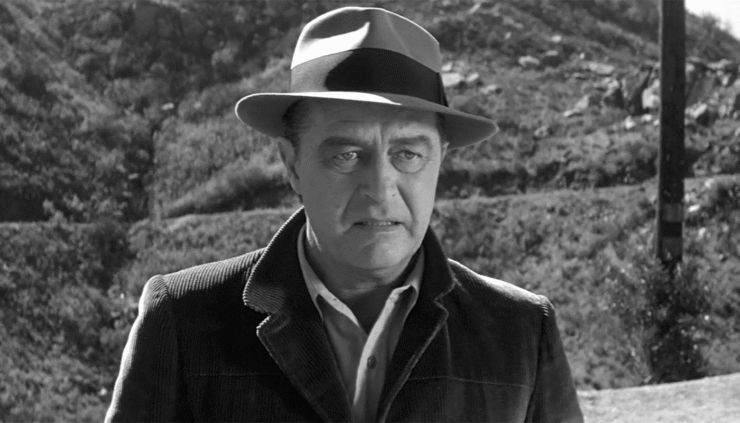
In Ray Milland’s film Panic in the Year Zero! (Based on Moore’s “Lot” and “Lot’s Daughter”), Los Angelinos Harry Baldwin and family set out on a camping trip. The Baldwins become aware something is wrong about 2 minutes, 45 seconds into the film. By about the 3-minute, 30-second mark, they see ominous flashes. At about the 6-minute mark, they witness a mushroom cloud rising over Los Angeles. At the 7-minute mark, emergency broadcast radio confirms atomic attack. At the 9-minute mark, Harry sees another man2 assault a gas station attendant. 10 minutes in, Harry abandons any thought of returning to rescue his mother-in-law. Over the next minute, Harry convinces himself civilization may have collapsed. At minute 13, Harry asserts survival will have to be on an individual basis. Finally, at just under the 23-minute mark, Harry commits his first survival-related crime.
Now, Panic was not filmed in real time. The 10 minutes between the Baldwins suspecting something is up and Harry concluding it is every man for himself is probably somewhat longer. An hour seems like a reasonable guess.
Therefore, I suggest one hour as the basic unit of measurement for the interval between characters discovering there is a crisis and them deciding to chuck every civilized value overboard in the name of survival. I further propose this unit be henceforth be known as “the Baldwin,” in honour of Harry, who with his family contributed absolutely nothing to the (entirely successful) US war effort in the course of the Baldwins’ post-apocalyptic crime spree.
I don’t know if the Baldwin will be useful to you all, as a concept, but I suspect I will get considerable use out of it.
- Researching “Cosmic Circle” and “Claude Degler” can only surprise and delight you. ↩︎
- Who also witnessed the attack and its effects. ↩︎

It should be noted that several of the texts you name are written by persons of the, shall we, hoping to avoid search engines, say dexter faction, who seem quite sympathetic with survivalist cults such as one might easly discover (though not, perhaps, so easily depart from) in, to pick an example, the panhandle of Idaho; and, as such, are simply waiting for the first hint of the Fall Of Civilization to drop the portcullis, arm the kill zones, and begin leafing through their dogeared copies of Atlas Shrugged, The Anarchist’s Cookbook, and To Serve Man; but I do not take such persons or their texts as particularly representative of humanity in general, or the SFF community in particular, any more than I do the utopian cults that seem to coagulate around certain texts (some Stranger than others), and form communes dedicated to free love and constant bathing: humanity, in general, like the SFF in particular, is a potage of many types of weirdos; the weirdest of all being someone who seems normal. As the late Jimmy Buffett sung: Fruitcakes in the kitchen, fruitcakes in the street/Strutting naked in the crossroad in the middle of the week/Half-baked cookies in the oven, half-baked people on the bus/There’s a little bit of fruitcake left in every one of us.
And, after all, when you want to write an exciting story, or make a thrilling movie, something that brings out violence in the first scene or two is generally going to grab those crowds faster and more reliably than deep philosophical discussion. As Deep Throat almost said: Follow the monkey.
What sticks in my memory is the last scene of Panic, where the Army patrol tells the Baldwins the war is over, and one of the soldiers says “We’ll need good people like them to rebuild”. Never have decided if that was a wink & nod to audience about how horrible Harry was, or if the screenwriter actually thought Harry was a good guy.
Panic in Year Zero! struck me as basically a survivalist tract and how-to guide. It seemed a little too eager to insist that going to the worst extremes was the necessary and correct reaction in that situation. Maybe it was trying to dramatize the ethical debate about pragmatic survival versus civilization, but it felt heavy-handed and not as balanced as it could’ve been, since the wife’s protests were always handily shot down by Milland’s pragmatic arguments, and he just seemed to be presented as this wise authority figure who had all the answers, so that he came off as more of a mouthpiece for the filmmakers (or rather, director Milland himself lecturing the audience) than an ambiguous character.
It didn’t help that Ray Milland had such a domineering and cold persona as a rule. There were times he felt to me more like an abusive paranoid holding his family hostage than a heroic protagonist. Although I guess that’s partly because husbands and fathers in the ’50s were expected to be absolute authorities over their households. In that way and others, it plays differently to modern eyes than it probably did when it came out.
let’s give a shout-out to GO GO GO SAID THE BIRD, by Sonja Dorman, which I think was in the second DANGEROUS VISIONS anthology
Troubled I went looking for real world examples of what actual people have really done when civilization “collapsed.”
We have three good modern examples:
No lone wolves, as they get dealt with quickly and they can’t secure enough food, water, security, and shelter for themselves (I left medicine out because one person is one mistake away from medically bidoofing their self).
Neighborhood/village sized groups and strong tribalism. Rigid binary value: you’re either in the group and helping or you’re out. No Good Samaritans outside your group.
Hard bartering, no more money or abstracts, just practical reality.
Collective defense and resource scavenging, and the local area will eventually be stripped down to any possible use (think how all the trees and anything made of wood in Sarajevo was stripped and burned).
So if anything within the first day things would rapidly settle out, and definitely by the end of the first week, month, etc.
I found it very interesting how all the adult males on Pitcairn Island were dead except one by the end of it all, and he survived using a strong patriarchal system using the last remaining copy of the ship’s bible. Reading accounts from Sarajevo survivors is fascinating too, especially in how no one makes it on their own. The data even seems to indicate that an individual, immediate family unit will not survive.
Human animals need civilization, even if stone-based, hunter-gatherer and tribal. It is our natural baseline. So a lot of post-apocalyptic fiction is ruined for me because it’s just sado-masochistic sociopathic violence porn.
Check out https://reactormag.com/ixnay-on-the-post-apocalyptic-cannibals-rebecca-solnits-a-paradise-built-in-hell/ for more on what actually happens in such circumstances.
James, please remove the apostrophe here in the second paragraph:
It’s lack came to me . . .
And then in the last paragraph perhaps effect is supposed to be effort here:
the (entirely successful) US war effect
Updated.
At least you read The Death Of Grass under it’s original title. The American No Blade of Grass was more obscure.
Alas, Babylon manages to largely avoid the trope. There were a few mentions of marauding bands of raiders, but for the most part, the characters who survive do it by working together. I think that is much more realistic.